Every music tradition has its defining instrument — the guitar in blues, the sitar in Indian classical, the djembe in West African drumming. For Mauritius, that instrument is the ravanne. This large, circular frame drum, made from a wooden hoop stretched with goatskin, is the primary percussion instrument of sega tipik — the island's oldest and UNESCO-listed musical tradition — and the rhythmic backbone of sega music more broadly, as well as a powerful symbol of Mauritian cultural identity. Held in both hands and warmed beside a fire before playing, the ravanne has set the rhythmic pulse of Mauritian music for over three centuries. Without it, sega as we know it would not exist.
This guide covers where the ravanne came from, how it is built and played, the role it holds in sega and seggae, where to hear it live today, and answers to the questions people most often ask about it.
- Origins of the Ravanne
- How a Ravanne Is Made
- Tuning by Fire
- Playing Techniques
- The Ravanne in Sega Music
- The Ravanne in Seggae: Kaya's Influence
- Where to Find Ravanne Music Today
- Frequently Asked Questions
Origins of the Ravanne
The ravanne traces its roots to the African and Malagasy communities brought to Mauritius during the French colonial period (1715-1810). Enslaved people were forced to work the island's sugarcane plantations, arriving from West Africa, Mozambique, Zanzibar, and Madagascar, each community carrying its own musical inheritance. Among the instruments they brought were African tam-tam drums. With limited access to materials, these communities adapted what they could find — wood, goatskin, and small stones — into an entirely new instrument, recreated on the island in the one space where authorities could not fully reach: the interior life of a community.
By the early 19th century, an estimated 60,000 enslaved Africans lived on Mauritius, representing roughly 80 per cent of the population. The music they developed was not mere entertainment — it was a form of psychological sustenance, a means of maintaining dignity and expressing grief when open practice of ancestral religions was suppressed.
The name "ravanne" is believed to derive from similar drum names in East African and Malagasy traditions. Related drums exist elsewhere in the Indian Ocean: the instrument is called ravan in Réunion and raban in other regional contexts. In Mauritius, the ravanne evolved to suit the specific rhythms and social functions of sega, becoming distinct from its African ancestors while retaining the same fundamental principle — a single membrane stretched over a circular frame, played with bare hands — and became the sonic centrepiece of what would eventually be called sega tipik, carrying centuries of collective memory inside its stretched goatskin head.
How a Ravanne Is Made
Traditional ravanne construction is a craft passed down through generations, straightforward in concept but demanding in execution.
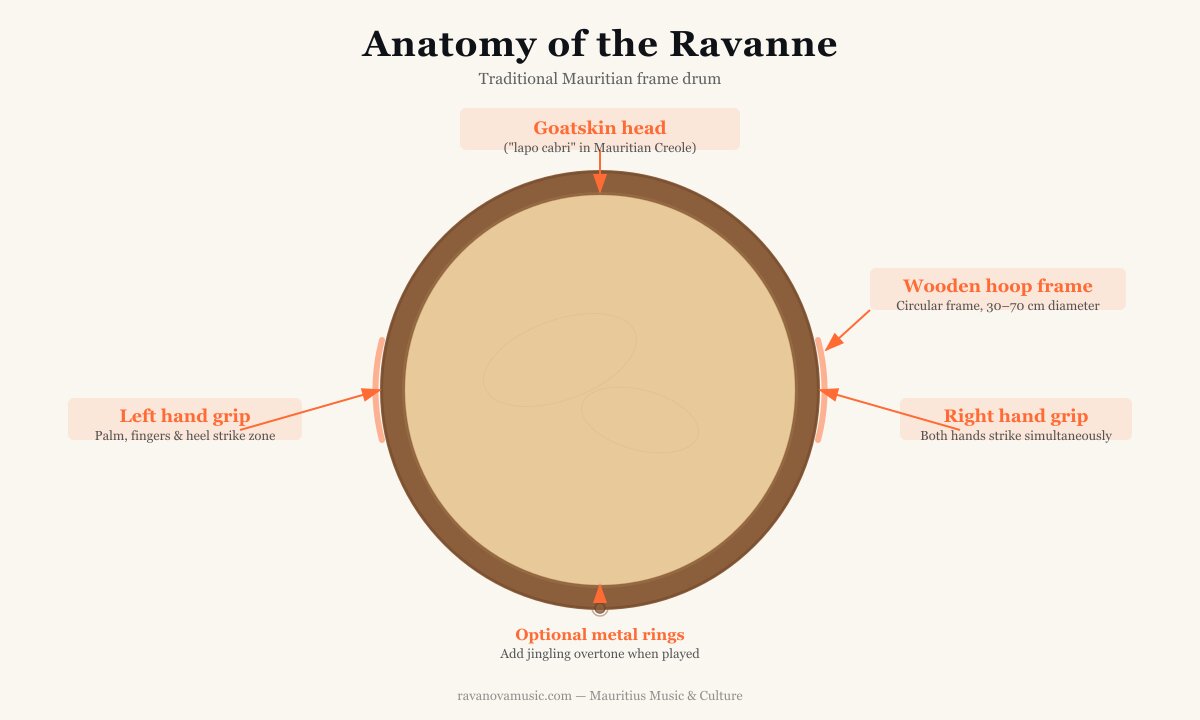
- The frame: A circular wooden hoop — handmade and variable: most performance drums measure roughly 40 to 70 centimetres across, larger traditional frames up to 90 centimetres, learner instruments from around 17 centimetres, with a depth of around 8-12 centimetres. Larger drums produce a deeper, more resonant tone, while smaller ones are lighter and easier to carry. Traditionally made from the wood of the casuarina or eucalyptus tree, bent into shape while the wood is still green and flexible.
- The skin: Goatskin — known in Mauritian Creole as lapo cabri — is the traditional membrane material. It is soaked, stretched tightly across the frame, and secured with rope, nails, or wooden pegs. Getting the tension right is critical: too slack and the drum produces a dull, indistinct sound; too tight and it risks cracking. Historically, stingray skin was also used, though its rough texture had to be sanded smooth once dried and stretched.
- Optional metal rings: Some ravannes include three small holes fitted with metal rings set into the hoop. These rattle and jingle as the drum is played, adding a shimmering overtone that layers over the fundamental beat — a detail that distinguishes certain ravannes from plainer frame drums found elsewhere in the Indian Ocean region.
Some modern ravanne makers use synthetic materials for the drumhead, which eliminates the need for fire-tuning but sacrifices the organic tonal quality that traditionalists prefer. Today, traditional makers of the ravanne are rare on the island, as goats are less commonly farmed in Mauritius than they once were, making quality goatskin harder to source. One documented retailer, Abaim (abaim.mu), sells traditional Mauritian instruments including the ravanne for those who want to purchase rather than commission one directly.
| Part | Detail |
|---|---|
| Goatskin head | Lapo cabri in Mauritian Creole — the striking surface |
| Wooden hoop frame | Circular frame, roughly Varies by maker: roughly 40-70 cm across (up to 90 cm), 8-12 cm deep |
| Frame wood | Traditionally casuarina or eucalyptus, bent green |
| Hand technique | Both hands strike together — palm, fingers, and heel in turn |
| Optional metal rings | Set into hoop holes — add a jingling overtone when played |
Tuning by Fire
The most distinctive aspect of ravanne practice is its relationship with fire. Before each performance, musicians hold the ravanne near a flame or heat source. Heat causes the goatskin to contract and tighten, raising the pitch and sharpening the drum's voice. This is not a ritual detail for its own sake — it is a practical necessity rooted in the physics of stretched animal skin. During a long performance, the player will return the drum to the fire periodically as the skin cools and begins to loosen.
This is precisely why traditional sega performances are held around a central fire, lit outdoors from early evening onward. The fire is not decorative; it is as essential to the music as the drum itself, and the tuning ritual is itself a significant part of the sega performance tradition.
Playing Techniques
The ravanne is played with both hands at the same time, held vertically or at a slight angle. Unlike a djembe or conga, where the drum sits on the ground or between the legs, the ravanne is often held aloft or balanced on one knee, giving the player freedom of movement. Playing involves the whole hand rather than just the fingertips — the player uses the palm, the fingers, and the heel of each hand in turn to produce different tones and textures, a technique that distinguishes it from many single-hand frame drum traditions found elsewhere.
Key techniques include:
- Open tone: Striking the centre of the skin with flat fingers produces a deep, resonant bass note
- Slap: A sharp strike near the edge creates a high-pitched crack that cuts through the ensemble
- Muted tone: Pressing the non-striking hand against the skin while hitting produces a dry, controlled sound
- Rolls: Rapid alternating strikes create sustained, building patterns used in climactic sections of sega performances
A skilled ravanne player can produce an extraordinary range of sounds from this deceptively simple instrument — a sharp crack from the centre, a warmer resonance from closer to the rim, a muted thud from a flat palm — controlling the dynamics and energy of an entire sega performance. The interplay between these tones within a single rhythmic pattern is what gives the ravanne its expressive range.
The Ravanne in Sega Music
In sega tipik — the oldest and most traditional form of Mauritian sega — the ravanne is not one instrument among many. It is the anchor, so central to the tradition that the genre is sometimes called sega ravanne. When the ravanne stops, sega tipik effectively stops. It sets the tempo, signals transitions, and drives the energy of the performance, while the maravanne (a light wooden frame faced with panels of bound sugarcane-stem, filled with dried seeds or small pebbles, shaken continuously to create a sandy, rustling texture) and the triangle (struck with a metal rod for a bright, cutting accent) fill the space between beats and follow the ravanne's lead.
Together, these three instruments create the rhythmic architecture on which sega is built. Vocals, delivered in Mauritian Creole, sit above this rhythmic foundation. A soloist improvises lyrics — often humorous, often melancholic, always personal — while the group responds in chorus, a call-and-response structure that mirrors West African musical traditions carried across the ocean centuries ago.
The relationship between the ravanne player and the dancers is intimate and improvisational. The drummer watches the dancers and responds to their movements, accelerating the rhythm to build intensity and pulling back to create moments of tension — this interplay between drum and dance is the essence of live sega. (Read more about how sega dance works.)
The genre was inscribed on the UNESCO Representative List of Intangible Cultural Heritage of Humanity on 27 November 2014, with the listing describing sega tipik as a performing art emblematic of the Creole community, rooted in the 18th-century convergence of African cultures under slavery. The ravanne was specifically highlighted as central to the tradition, and the recognition has spurred renewed interest in traditional ravanne-making and playing techniques, with workshops and cultural programmes ensuring the craft is passed to new generations. Several Mauritian musicians, including Menwar, have made the preservation of ravanne tradition a central part of their artistic mission, performing with traditional acoustic instruments rather than modern electronic setups.
Two figures stand out in the documented history of sega tipik. Ti Frère — born Jean Alphonse Ravaton on 22 April 1900 in Quartier Militaire, district of Moka — is widely called the "Father of Mauritian Music." He recorded his first sega, "Tamassa," in 1925, and received the title "King of the Sega" in 1964. Serge Lebrasse, born 25 June 1930 in Rose Hill, was among the first to perform sega at formal public functions, backed by the Mauritius Police Force Band in the late 1950s. Sega Day, commemorated on 6 April each year, marks the anniversary of his death.
The Ravanne in Seggae: Kaya's Influence
The ravanne's survival into modern Mauritian music owes much to seggae, the genre that fused sega with reggae and took Mauritius by storm from the mid-1980s onward. Seggae was created by Kaya — born Joseph Réginald Topize on 10 August 1960 in Roche-Bois, Port Louis — who took his stage name from Bob Marley's 1978 album Kaya (and its title track). Of mixed Mauritian Creole and Indian heritage, Kaya wrote Creole-language songs addressing social inequality, spirituality, and love, rooting them firmly in African, Creole, and Caribbean musical traditions.
In seggae, the ravanne does not disappear. It sits alongside electric guitar, bass, and reggae-influenced rhythmic patterns, providing cultural continuity in a genre that might otherwise have drifted entirely toward its international influences. The drum's presence in seggae is a declaration: this music, however modern it sounds, belongs to Mauritius.
Kaya died on 21 February 1999 while in police custody, triggering significant civil unrest across the island. His music remains foundational to Mauritian popular culture, and the ravanne's role within it remains a living thread connecting the genre back to its origins in the plantation era. Read more about the history of seggae in Mauritius.
Where to Find Ravanne Music Today
The places most reliably associated with authentic ravanne playing are the coastal fishing villages, where traditional sega ravanne has been maintained more consistently than in urban centres. These communities have kept the instruments, the knowledge of how to warm the skin, and the call-and-response vocal style as living practice rather than preserved heritage.
Formally, the annual Sega Tipik Festival — typically held in September — brings together local musicians and dancers for live performances and workshops where the ravanne takes centre stage. The International Kréol Festival, held in late October or early November to coincide with the commemoration of the abolition of slavery, includes sega concerts and storytelling where traditional instruments are regularly featured. Both provide accessible entry points for visitors who want to experience ravanne music in context rather than as a hotel performance — see our wider guide to music festivals in Mauritius for more.
In Port Louis, the Caudan Waterfront area has documented traditional sega performances alongside bars and restaurants. Grand Baie on the north coast is the primary nightlife hub, with venues like Lakaz Cascavelle hosting regular sega evenings.
The best way to understand the ravanne, though, is to hear it live — the resonance of goatskin, the heat of the fire, the energy of the dance. At Ravanova Music, we document Mauritius's music traditions, from the earliest recordings of Ti Frère to contemporary seggae artists, with the aim of making this history accessible to anyone with an interest in Indian Ocean culture. The ravanne is the instrument where that story begins, and it remains the instrument around which it continues to turn. For recorded ravanne music from Mauritian creators, explore Ravanova Music on iOS and Android.
Frequently Asked Questions
What is the ravanne instrument?
The ravanne is a traditional Mauritian frame drum consisting of a circular wooden hoop over which goatskin — called lapo cabri in Mauritian Creole — is stretched tightly. It is the central percussion instrument of sega tipik, the UNESCO-listed traditional music of Mauritius. The drum is held in both hands and struck with the palm, fingers, and heel to produce varied tones.
What is the ravanne made from?
A ravanne is made from a circular wooden hoop, traditionally casuarina or eucalyptus, and a goatskin drum head. Historically, stingray skin was also used. Some ravannes have three small metal rings fitted into the hoop, which add a jingling overtone. Sizing is handmade and variable: most performance drums measure roughly 40 to 70 centimetres across, larger traditional frames up to 90 centimetres, learner instruments from around 17 centimetres, with a depth of around 8-12 centimetres, depending on the maker.
Why is fire used when playing the ravanne?
The goatskin drum head tightens when exposed to heat, which raises the pitch and sharpens the tone of the drum. Ravanne players hold the instrument near a fire before and during performances to keep the skin warm and the tuning consistent. This is why traditional sega performances are held around a central fire outdoors. Some modern makers use synthetic drumheads specifically to avoid this step, though traditionalists consider the fire-tuned tone irreplaceable.
What is the difference between the ravanne and the maravanne?
The ravanne is a frame drum played with the hands; it provides the rhythmic foundation of sega tipik. The maravanne is a light wooden frame faced with panels of bound sugarcane-stem, filled with dried seeds or small pebbles and shaken to create a continuous sandy rustling sound. Together with the triangle, they form the three core instruments of traditional sega.
What does ravanne mean in sega tipik?
The ravanne is so central to traditional Mauritian sega that the oldest form of the genre is often called sega ravanne. Its presence defines the music's character: without the ravanne, sega tipik loses its rhythmic anchor and its direct connection to the African percussion traditions that gave birth to the genre.
Is the ravanne still being made today?
Yes, though traditional makers are increasingly rare. Sourcing goatskin in Mauritius has become more difficult as goat farming has declined. Abaim (abaim.mu) is one documented retailer that sells the ravanne alongside other traditional Mauritian instruments. The drum is still actively maintained in coastal fishing communities and in cultural organisations dedicated to sega tipik.
When was sega tipik recognised by UNESCO?
Traditional Mauritian Sega was inscribed on the UNESCO Representative List of Intangible Cultural Heritage of Humanity on 27 November 2014. The inscription recognises the tradition's origins in the 18th-century convergence of African cultures under slavery and its role as a symbol of national identity in Mauritius.
Related reading: Learn about sega, the genre the ravanne powers, discover seggae, the fusion born from sega, meet the musicians preserving the tradition, or explore all Mauritian genres on our Mauritian Music hub page.