If you have ever visited Mauritius, you have heard sega. It pulses through beach parties, hotel lobbies, street festivals, and national celebrations — the sound of the island, joyful, rhythmic, and unmistakably Mauritian. But sega is far more than holiday entertainment. It is the national music and dance of Mauritius, built around a frame drum called the ravanne and performed in Mauritian Creole through call-and-response vocals, accompanied by swaying, hip-driven dance. In 2014, UNESCO inscribed Traditional Mauritian Sega on its Representative List of the Intangible Cultural Heritage of Humanity. This guide covers where sega came from, the instruments and artists that shaped it, how it differs from its offshoot seggae, and where to hear it today.
Contents
- The Origins of Sega Music in Mauritius
- The Instruments That Define Sega
- How Sega Is Performed and Danced
- Sega Legends: The Artists Who Shaped the Sound
- Sega vs Seggae: What Is the Difference?
- UNESCO Recognition
- Modern Sega Today
- Where to Hear and Stream Sega Music Today
- Frequently Asked Questions
The Origins of Sega Music in Mauritius
Sega emerged from one of the most painful chapters in Mauritian history. During the French colonial period (1715-1810), colonial authorities transported enslaved men and women from across Africa and Madagascar — documented source regions include West Africa, Mozambique, Zanzibar, and Madagascar itself — to work the island's sugarcane estates. By the early 19th century, around 60,000 enslaved Africans lived on the island, representing approximately 80 per cent of the total population.
Stripped of legal rights and unable to practise their ancestral religions openly, these communities gathered around bonfires on the beach to sing, drum, and dance. These gatherings — raw, communal, and defiant — were the birthplace of sega. Music became a space where identity could survive when almost nothing else could; it has been called, with good reason, the blues of the Indian Ocean.
The music served as a form of oral storytelling. Through improvised call-and-response vocals in Creole, a lead singer shared stories of love, hardship, longing for home, and the injustices of daily life, while the group responded. The lyrics were often coded, allowing singers to express dissent without direct confrontation with colonial authorities — an oral, spontaneous quality, with lyrics arriving in the moment and never quite repeated, that remains one of sega's defining characteristics.
The earliest musicians brought African tam-tam drums and other percussion across the ocean, then improvised new instruments from the materials available: wood, goatskins, and small stones.
Because the same trade routes that brought enslaved people to Mauritius also connected the wider Indian Ocean, sega spread quickly. Réunion, Rodrigues, Seychelles, the Comoros, and Mayotte each developed their own versions, adapted to local languages and conditions. The Réunion variant, known as maloya, shares the same slave-era roots and was inscribed on the UNESCO Intangible Cultural Heritage list in 2009, five years before Mauritius's own inscription. These are distinct genres, but their shared origin in Indian Ocean plantation life links them at a deep level.
The Instruments That Define Sega
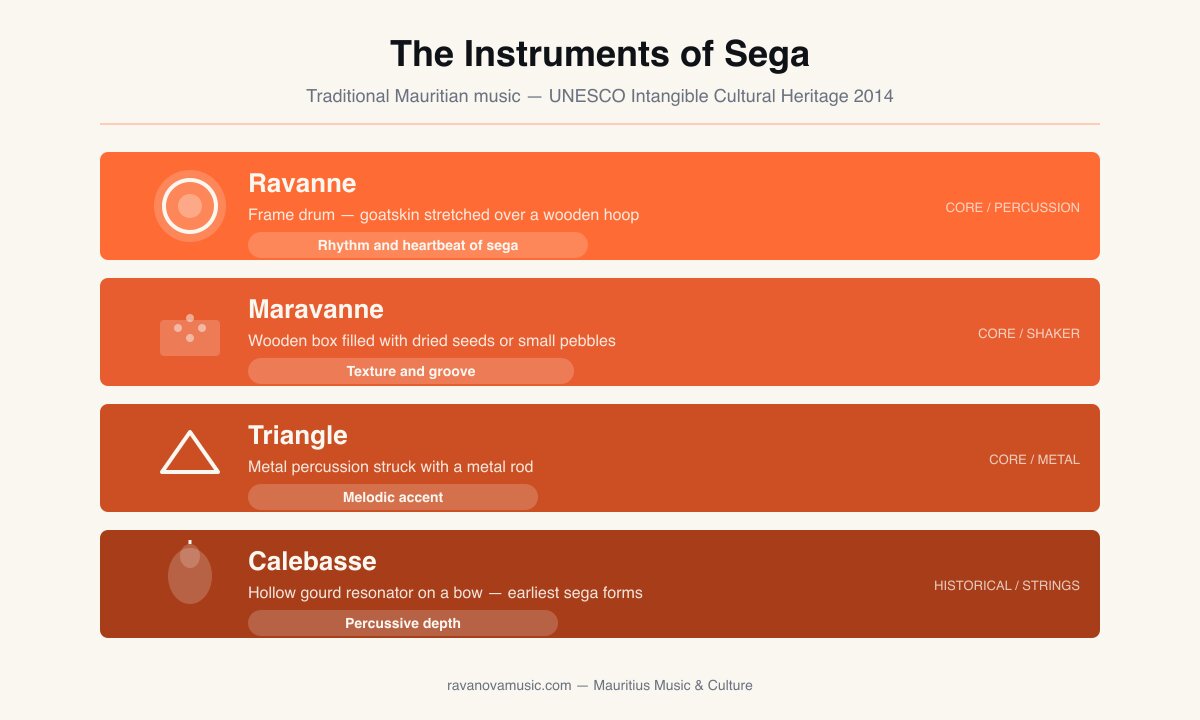
Four instruments form the core of traditional sega. The first three — the ravanne, the maravanne, and the triangle — are the defining instruments of sega tipik, the form recognised by UNESCO. The calebasse belongs to the earliest recorded versions of the music. For a broader look at these and other instruments, see our guide to traditional Mauritian instruments.
| Instrument | Type | Description | Role in Sega |
|---|---|---|---|
| Ravanne | Core / Percussion | Frame drum — goatskin stretched over a wooden hoop | Rhythm and heartbeat of sega |
| Maravanne | Core / Shaker | Rectangular wood-framed rattle with reed or sugarcane-stem panels enclosing seeds | Texture and groove |
| Triangle | Core / Metal | Metal percussion struck with a metal rod | Melodic accent |
| Calebasse | Historical | Hollow gourd resonator on a bow — earliest sega forms | Percussive depth |
The Ravanne
The ravanne is the heartbeat of sega. It is a frame drum: goatskin — known locally as lapo cabri — stretched tightly over a circular wooden hoop. Hoop sizes are handmade and variable — most performance drums measure roughly 40 to 70 centimetres across, larger traditional frames can reach up to 90 centimetres, and learner instruments start from around 17 centimetres. Some frames include small metal rings fitted into holes along the hoop, adding a faint jingling overtone when the drum is struck. Historically, the earliest versions sometimes used stingray skin, which had to be sanded smooth once dried and stretched.
The ravanne is held in both hands and struck with the palm, fingers, and heel to produce a range of tones, played with both hands simultaneously — unusual among frame drums. Before playing, the skin is held close to an open fire to warm it, tightening the membrane and raising the pitch. This is not incidental: it explains why traditional sega is performed outdoors around a fire. The entire genre is sometimes called sega ravanne after this instrument.
The Maravanne
The maravanne is a rectangular wood-framed rattle: a light wooden frame holds panels of bound reed or dried sugarcane-flower stems on its front and back faces, enclosing small seeds inside. When shaken, it produces a continuous sandy rustling that fills the spaces between ravanne beats, binding the rhythm together. Where the ravanne lands each pulse, the maravanne holds the groove between pulses, giving sega its characteristic rolling, hypnotic texture.
The Triangle
The triangle in sega is a bent metal rod struck with a smaller metal rod. Its bright, cutting tone cuts through the deeper frequencies of the ravanne and maravanne, providing a high-pitched rhythmic accent and a metallic sparkle. Alongside the ravanne and maravanne, it forms the three-instrument core of sega tipik as defined in the UNESCO inscription.
The Calebasse
The calebasse is a hollow gourd that functioned as the resonating body of a single-string bow instrument in the earliest forms of sega. The player held the gourd against their chest or stomach while plucking the string, using the body cavity to amplify and colour the sound. It does not feature prominently in modern sega but represents the deepest historical layer of the music, directly linked to African musical traditions carried across the ocean by enslaved musicians.
Modern sega has expanded to include electric guitars, bass, keyboards, drum machines, and full studio production. But even in its most contemporary form, the ravanne remains the spiritual heart of the genre.
How Sega Is Performed and Danced
Traditional sega is not a concert with a stage and an audience — it is communal, built around participation. Performances take place outdoors in the open air, starting in the evening and running through the night. A fire is lit at the centre of the gathering, and the ravanne player holds the drum close to the flames between beats to keep the skin warm and taut, the pitch of the drum shifting audibly as it heats.
A lead vocalist improvises lyrics while the group responds — a call-and-response structure that goes back directly to the African musical traditions the first enslaved musicians carried to Mauritius. The audience and musicians form a circle together; there is no clear line between performer and spectator, and people join the dance when they feel moved to do so. At festivals and beach performances today, audiences are invariably drawn in — sega is participatory by nature.
Sega dance is performed by couples or by one woman with several partners. Performers — traditionally barefoot — move with swaying hips, short shuffling steps, and undulating, flowing gestures of the hands and upper body, reflecting the genre's African roots with movements that are both grounded and fluid. Women often wear brightly coloured, flowing skirts that accentuate the hip movements, while men dance with more angular, athletic footwork. The dance is earthy and expressive, reflecting its origins as a release from daily hardship rather than a formal performance art.
Tempo builds progressively through the night: earlier pieces are slower and atmospheric, and the energy rises as the hours pass, until a gentle sway becomes an energetic, full-body expression of joy and release. If you want to learn the steps yourself, see our guide on how to learn sega dance.
Sega Legends: The Artists Who Shaped the Sound
Ti Frère, the Father of Mauritian Music
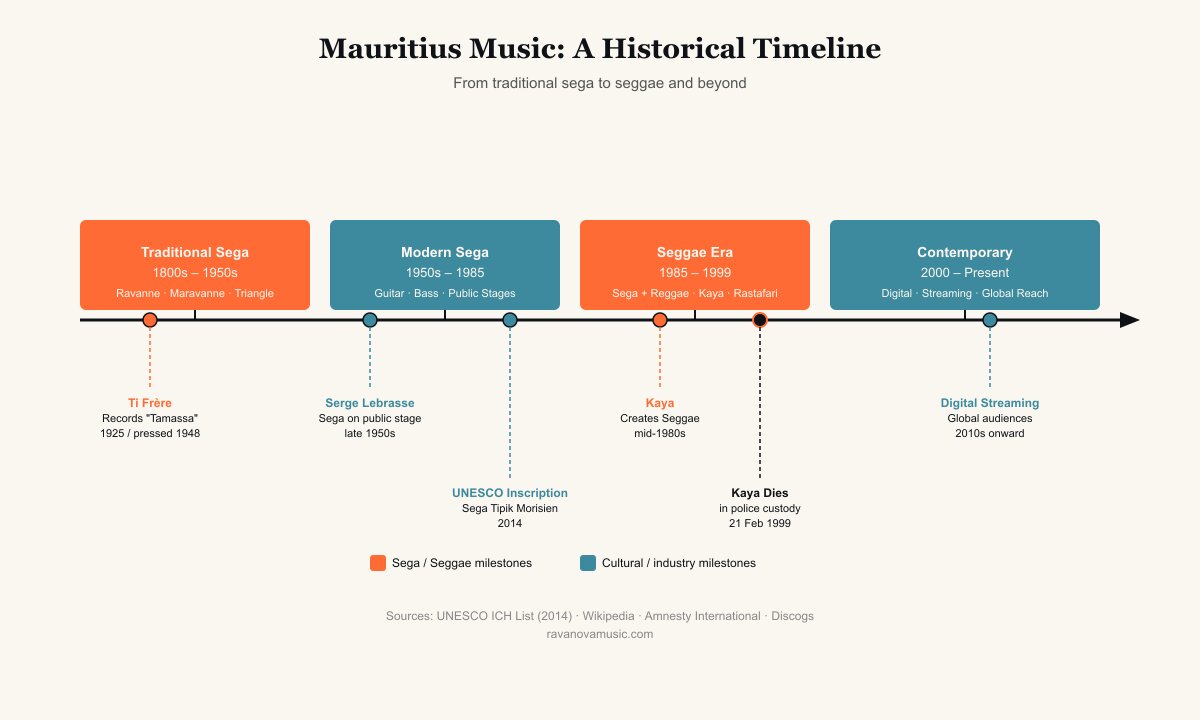
Ti Frère — born Jean Alphonse Ravaton on 22 April 1900 in Quartier Militaire, in the district of Moka — is the most revered figure in Mauritian music history. His father, of Malagasy origin, was himself a sega singer who held private bal bobesse gatherings. Ti Frère was reportedly unable to read or write, but he could improvise lyrics on demand and compose songs that lodged themselves permanently in the island's cultural memory.
He recorded his first sega, "Tamassa," in 1925. The recording was later pressed as the first 45 rpm record manufactured in Mauritius, in 1948. By 1964 he had received the title King of the Sega. Songs including "Charlie Oh," "Anita," "La grain café," "Roseda," and "Papitou" remain widely recognised in Mauritius today. Ti Frère died in 1992 and is consistently referred to as the Father of Mauritian Music.
Serge Lebrasse
Serge Lebrasse — full name Joseph Emmanuel Serge Lebrasse, born 25 June 1930 in Rose Hill — spent 17 years as a primary school music teacher while building his career as a sega artist. He was among the first performers to take sega out of private settings and present it at formal public functions, including concerts backed by the Mauritius Police Force Band in the late 1950s. That shift mattered: it helped establish sega as a legitimate national art form rather than an informal community tradition.
Lebrasse is also remembered through the annual calendar. Sega Day, observed on 6 April each year, commemorates the anniversary of his death and is now a national occasion dedicated to celebrating the genre he helped elevate.
Fanfan
Fanfan was one of the last musicians to keep sega ravanne alive in its most traditional, acoustic form during the mid-20th century. A composer, storyteller, and poet, he earned the title of the griot of Mauritius — the word griot referring to the West African tradition of the musician as community historian and keeper of oral knowledge. Fanfan was prominent in the 1950s and 1960s, a period when modernisation threatened to push the acoustic form to the margins.
Kaya and the Birth of Seggae
Kaya — the stage name of Joseph Réginald Topize, born 10 August 1960 in Roche-Bois, Port Louis — invented seggae in the mid-1980s by fusing sega with reggae, choosing his stage name from a Bob Marley song. Kaya died on 21 February 1999 while in police custody following an arrest for smoking marijuana at a concert; his death triggered significant civil unrest across the island. Seggae remains one of the most popular genres in Mauritius today, and Kaya's influence is still felt across the contemporary music scene. Read the fuller story in our history of seggae and our guide to famous Mauritian male singers.
Sega vs Seggae: What Is the Difference?
Sega tipik — the acoustic, ravanne-led form described throughout this article — is the root. Seggae is a distinct genre that grew from it. Kaya brought together the Creole rhythms and social consciousness of sega with the bass-driven grooves and spiritual lyrical tradition of Jamaican reggae. The result was something genuinely new: songs in Mauritian Creole addressing inequality, love, and spirituality, rooted in African and Caribbean heritage simultaneously. For more on how Mauritian genres compare with their Caribbean cousins, see Mauritian music vs Caribbean music.
In seggae, the ravanne still appears but shares rhythmic space with electric guitar, bass, and reggae-influenced drum patterns. The cultural anchor remains — the drum's presence roots the music unmistakably in Mauritius — but the sound is hybrid.
UNESCO Recognition
Traditional Mauritian Sega was inscribed on UNESCO's Representative List of the Intangible Cultural Heritage of Humanity on 27 November 2014. This recognition was a landmark moment for Mauritius, acknowledging sega's importance as a living cultural tradition and its role in expressing the identity and resilience of the Mauritian people. The inscription recognised the genre's origins in the 18th-century convergence of African cultures under plantation slavery and its role as a marker of national identity for the Creole community.
The UNESCO inscription specifically recognised the communal nature of sega, its role in social cohesion, and its transmission across generations through oral tradition rather than formal notation.
Modern Sega Today
Contemporary sega artists blend traditional rhythms with pop, R&B, hip-hop, and electronic production. The genre has evolved while maintaining its core identity — syncopated rhythms, Creole lyrics, and themes that reflect Mauritian life.
Sega is performed at virtually every cultural event in Mauritius: the Festival International Kreol, Independence Day celebrations, weddings, and major concert events, including the season of concerts in Mauritius. International tourism has also amplified sega's reach, with hotel performances introducing millions of visitors to the genre each year.
Sega originated within the Creole community — the descendants of enslaved Africans and Malagasy people — and remains most closely associated with that community in its traditional form. In contemporary Mauritius, however, it crosses cultural and ethnic lines: audiences and performers from the island's Indo-Mauritian, Franco-Mauritian, and Sino-Mauritian communities all engage with sega, and it is widely understood as a shared national heritage. Lyrics remain in Mauritian Creole, the language at the heart of the genre.
One notable modern variant is sega bhojpuri — also called sega chutney or sega bollywood — which blends the sega three-count rhythm with Bhojpuri-language lyrics and Indian instruments such as the dholok drum and tabla. It developed within the Indo-Mauritian community, whose ancestors arrived as indentured labourers after the abolition of slavery, and sits alongside other modern variants such as sega pop, sega zouk, sega disco, and sega salon.
Where to Hear and Stream Sega Music Today
Live Venues
Grand Baie on the north coast is the primary hub for live music in Mauritius. Bars, beach clubs, and venues there regularly programme sega and contemporary Mauritian music nights throughout the week. In Port Louis, the Caudan Waterfront area hosts traditional sega performances alongside bars and restaurants facing the harbour. On the west coast, Flic en Flac operates as a secondary nightlife destination, and Lakaz Cascavelle is a venue specifically noted for its sega evenings. See our full list of best music venues in Mauritius.
For the most traditional form of the music — sega ravanne played around a fire in the way it has been performed for centuries — the best locations are the island's coastal fishing villages, where the practice has been maintained most continuously.
Festivals
Three events stand out, covered in full in our guide to Mauritian music festivals. The Sega Tipik Festival, held annually in September, brings together live performances and dance workshops focused on the acoustic, traditional form. The International Kréol Festival takes place annually in December, with exact dates varying from year to year; it encompasses sega concerts, storytelling, traditional food, exhibitions, and open-air cinema, and has been running for over a decade. Sega Day on 6 April is a national day honouring the genre and the memory of Serge Lebrasse.
Weddings
Sega is routinely incorporated into Mauritian wedding receptions, often with live ravanne drummers and professional dancers as part of the evening programme. Grand Baie and Cap Malheureux on the north coast are particularly popular locations for destination weddings with ocean views. Modern Mauritian weddings may blend sega pop, seggae, and international music depending on the family's community and preferences.
Streaming
The best way to experience sega is live — at a beachside concert in Flic en Flac, a festival in Port Louis, or a village celebration. For streaming, Ravanova Music is a Mauritius-based platform dedicated to streaming and showcasing authentic Mauritian music, including sega tipik, seggae, and the full breadth of contemporary Mauritian sound, available on iOS and Android. See our full guide on how to stream Mauritian music.
Frequently Asked Questions
What does "sega" mean in Mauritius?
Sega refers both to the music genre and the accompanying dance. The word's exact etymology is debated, but the genre itself is defined by its instruments — principally the ravanne drum — its Mauritian Creole lyrics, and its roots in the experience of enslaved Africans on the island. Today it is recognised as the national music and dance of Mauritius.
When was sega recognised by UNESCO?
Traditional Mauritian Sega was inscribed on the UNESCO Representative List of Intangible Cultural Heritage of Humanity on 27 November 2014.
What are the three core instruments of sega tipik?
The three instruments at the heart of sega tipik are the ravanne (frame drum), the maravanne (rectangular wood-framed rattle with reed or sugarcane-stem panels enclosing seeds), and the triangle (metal percussion). These three are specifically named in the UNESCO description of the genre. The ravanne is considered the defining instrument and gives the traditional form its alternative name: sega ravanne.
Who is known as the Father of Mauritian Music?
Ti Frère (Jean Alphonse Ravaton, 1900-1992) is consistently referred to as the Father of Mauritian Music. He recorded his first sega in 1925 and received the title King of the Sega in 1964. His songs remain part of the living repertoire in Mauritius more than three decades after his death.
What is the difference between sega and seggae?
Sega is the traditional genre, built on acoustic percussion and Creole vocals. Seggae is a fusion created by Kaya in the mid-1980s that combines sega's rhythms and Creole language with reggae's bass-driven grooves, electric guitar, and social-lyrical tradition. The ravanne appears in both, but seggae incorporates a full electric band arrangement alongside it.
Is sega only for the Creole community?
Sega originated within the Creole community and remains most closely associated with that community in its traditional form. In contemporary Mauritius, however, it crosses cultural and ethnic lines, and it is widely understood as a shared national heritage.
What is sega bhojpuri?
Sega bhojpuri — also called sega chutney or sega bollywood — is a sub-genre that blends the sega three-count rhythm with Bhojpuri-language lyrics and Indian instruments such as the dholok drum and tabla. It developed within the Indo-Mauritian community, whose ancestors arrived as indentured labourers after the abolition of slavery.
Sega is more than music. It is the sound of survival, celebration, and identity. From the bonfires of enslaved communities to the stages of international festivals, it remains the heartbeat of Mauritius.
Related reading: Discover how sega inspired seggae, the fusion of sega and reggae. Meet the Mauritian musicians who defined the island's sound. Learn to move like a local with our guide on how to learn sega dance. Or explore all genres on our Mauritian Music hub page.